
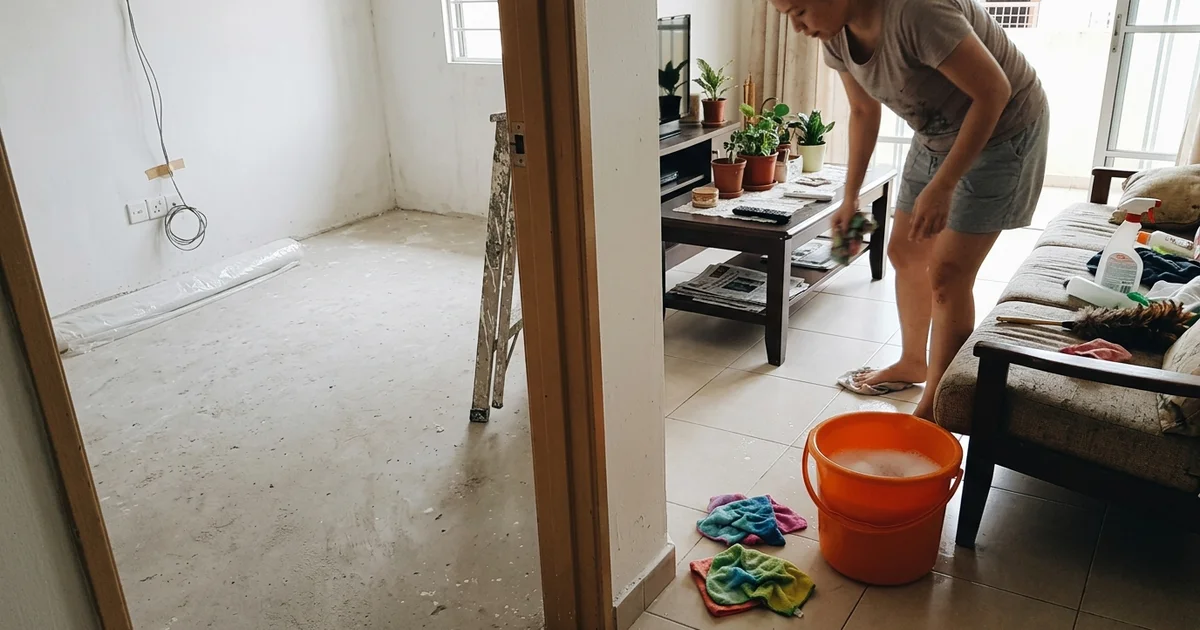
Two Services That Sound Similar and Aren’t
Both are intensive. Both cost more than a routine clean. Both take most of a day. That’s where the similarity ends.
Post-renovation cleaning removes construction residue: fine cement and gypsum dust, cement haze on new tiles, paint splatter, adhesive and sealant overrun. It’s about clearing what building work left behind.
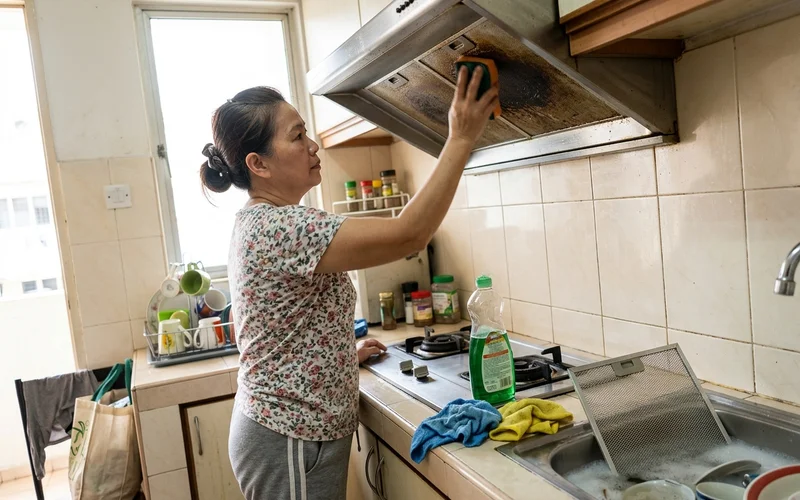
Deep cleaning removes the build-up of ordinary living: kitchen grease, bathroom limescale, dirty grout, dust on fan blades and grime in door tracks. It’s about resetting a space that’s been used.
Book the wrong one and you pay twice, because neither service substitutes for the other.
Side by Side
| Post-renovation cleaning | Deep cleaning | |
|---|---|---|
| What it removes | Cement and gypsum dust, haze, paint, adhesive | Grease, limescale, grout grime, built-up dust |
| Property state | Usually empty, post-build | Lived in and furnished |
| Key equipment | Industrial HEPA wet/dry vacuum, acid tile cleaner, blades | Degreasers, descalers, detail brushes, steam |
| Main risk | Etching new tiles, scratching new glass | Damaging older finishes with the wrong product |
| Typical trigger | Handover, renovation finished, new build | Neglect, pre-festive reset, moving between routine cleaners |
| Usual duration | Full day, often two cleaners | Half to full day |
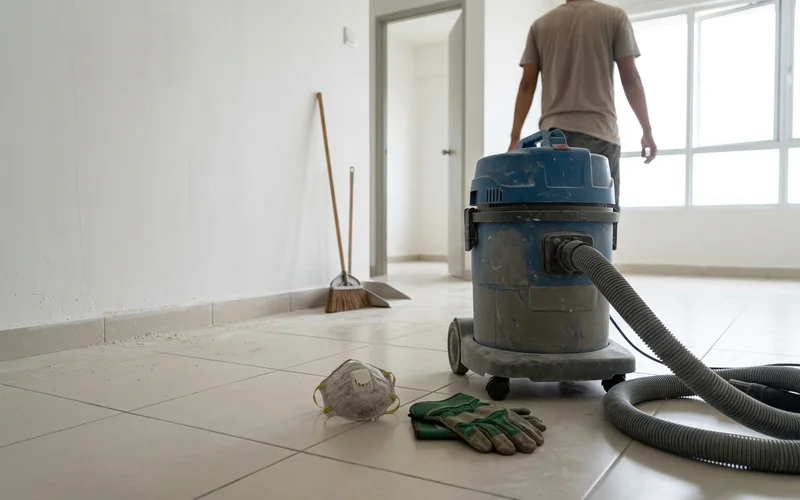
Why Renovation Work Needs Different Gear
This is the part that decides which service you actually need.
Construction dust is ground far finer than household dust. It stays airborne, drifts on any air movement and re-settles for days. A domestic vacuum exhausts the fine fraction straight back into the room, so the floor looks clean and the air doesn’t get better. HEPA-filtered industrial extraction captures it instead.
Cement haze is a bonded mineral film, not surface dirt. Detergent slides over it. Removing it needs a diluted acid cleaner matched to the tile, applied wet, in sections, with a test patch first.
Neither of those tools appears in a deep clean, because a lived-in home doesn’t need them.
Which One Do You Need?
Book post-renovation cleaning if:
- Contractors have finished in the last few weeks
- There’s a grey film that returns after you wipe it
- New tiles look dull or cloudy
- There’s paint on the glass or tape residue on the frames
- You’re taking handover of a new or refitted unit
Book deep cleaning if:
- The property is furnished and lived in
- The kitchen has visible grease build-up
- Bathroom taps and glass have white scale
- Grout lines have gone dark
- Nobody has properly cleaned it in six months or more
The quickest way to tell
If the mess arrived with the builders, it’s a post-renovation clean. If it arrived with daily life, it’s a deep clean.
If You’re Genuinely Between the Two
Some properties need both: a home that was renovated a while back, has since been lived in, and never had a proper clean at either point. That’s a real situation and we handle it as a single scoped job rather than two bookings.
Send photos on WhatsApp and we’ll tell you which service fits, or whether it’s the combined case. The assessment is free either way, and getting it right the first time is cheaper than discovering it halfway through.
The Sequence That Works After a Renovation
If you’ve just renovated and plan to live in the property, the order over the first year usually looks like this.
Week one: post-renovation clean. Empty property, full HEPA extraction, haze and residue removal. This is the specialist job, and doing it before furniture arrives keeps the hours down — the post-renovation cleaning checklist covers exactly what gets worked through.
Move in. Everything after this point is normal living rather than construction residue.
Months one to six: routine cleaning. A weekly or fortnightly slot to maintain what the post-renovation clean established. No need for anything intensive yet — the property starts from a clean baseline.
Around month six to twelve: first deep clean. By now the kitchen has cooked a few hundred meals and the bathrooms have built their first layer of scale. This is where a deep clean earns its keep.
After that: annual or twice-yearly deep cleans, with routine slots in between.
The mistake worth avoiding is booking a deep clean in week one instead of a post-renovation clean. Degreasers and descalers do nothing to cement haze or airborne gypsum dust, so you’d pay for a full day and still have a grey film on the windowsills the next morning.
Send photos if you’re not sure which stage you’re at. We’ll tell you straight, including when the honest answer is “you don’t need us yet”.